By John Miller, Director of Business Development • Published April 16, 2026 • Updated June 5, 2026 • Read Time 5 min
TL;DR
Volkswagen’s EA888 engine carries a documented timing chain stretch and tensioner failure issue that can escalate from a cold-start rattle to catastrophic engine damage if ignored. North Texas drivers should know the symptoms, understand why it happens, and know what a complete repair involves.
Volkswagen’s EA888 engine family — found in the Jetta, Golf, Passat, Tiguan, and CC — produces an excellent combination of fuel economy and performance in day-to-day driving. But this engine series carries a documented issue with timing chain stretch and tensioner failure that has affected a significant number of VW owners, particularly in earlier production years of the 2.0T TSI and 1.8T TSI variants. At Fifth Gear Automotive Repair, we’ve serviced a substantial number of VW timing chain cases and want drivers to understand what the failure looks like, why it happens, and what the consequences of ignoring it can be.
How the Timing Chain Controls Your VW’s Engine
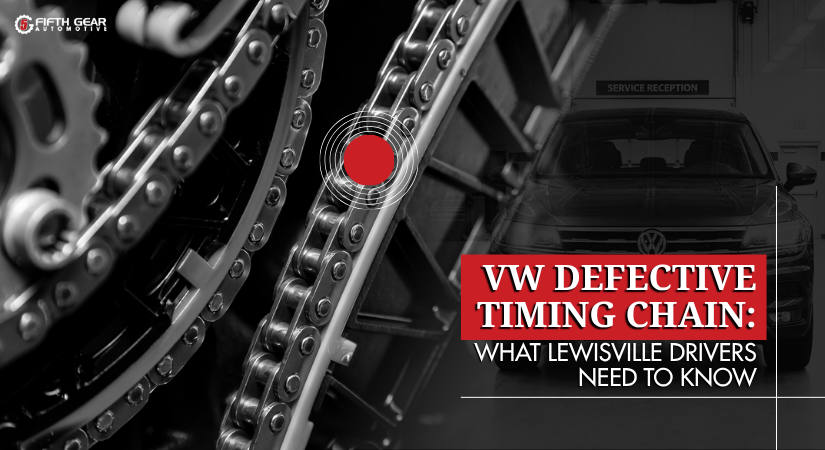
The timing chain synchronizes the rotation of the crankshaft and camshafts, ensuring that intake and exhaust valves open and close at precisely the right moment in relation to piston position. Unlike a timing belt, which has a scheduled replacement interval, a timing chain is designed to last the life of the engine — in theory. In practice, the EA888’s chain and tensioner system can develop problems that cause the chain to stretch and the timing to drift outside specification.
When timing drifts, the cam-to-crank relationship is off. Intake valves open too early or too late, combustion events occur with incorrect valve positioning, and engine efficiency drops. In severe cases, where chain stretch is extreme or a tensioner fails abruptly, the chain can skip a tooth on the sprocket — an event that can cause valve-to-piston contact in an interference engine, resulting in catastrophic internal damage
Common Symptoms of Timing Chain Problems in VW EA888 Engines
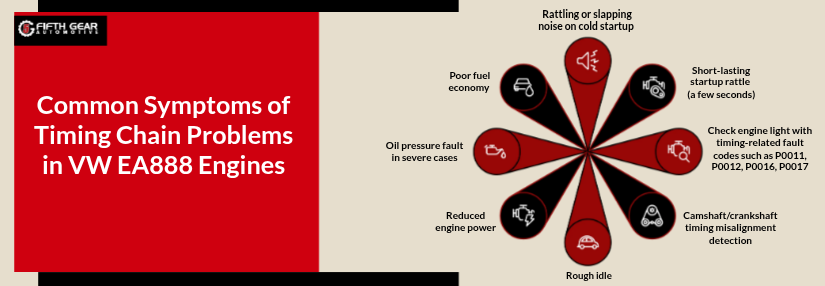
The most widely reported early symptom is a rattling or slapping noise on cold startup. This noise comes from the slack in a stretched chain as oil pressure hasn’t yet fully charged the tensioner. The rattle may last only a few seconds before the engine quiets down — which leads many owners to ignore it. This is a mistake. A chain that rattles at cold start is already stretched beyond acceptable tolerance and will continue to worsen.
Other symptoms include check engine lights with camshaft position timing error codes (P0011, P0012, P0016, P0017) stored in the engine control module. These codes indicate that the ECU is detecting a misalignment between crankshaft and camshaft sensor signals — a direct result of chain stretch causing timing deviation.
Rough idle, reduced power, and poor fuel economy can accompany advanced timing chain stretch as the engine management system attempts to compensate for incorrect valve timing. In worst-case scenarios, an oil pressure fault can develop in tandem, as the timing chain tensioner depends on adequate oil pressure to maintain chain tension.
“On the EA888, that cold-start rattle is usually a failing camshaft actuator. If you watch the cam lobe you’ll see it spin, stop, then continue spinning, and that’s what makes the noise. Once oil pressure builds the PCM can control cam timing, but until then a locking pin is supposed to hold everything in place. — Nick Gerleman, Technician, Fifth Gear Automotive Repair Aubrey – Cross Roads
Why the EA888 Timing Chain Fails Prematurely
The EA888’s timing chain is positioned at the rear of the engine — a design choice that reduces engine bay noise but makes the chain and tensioner system much less accessible for inspection and service. This rear-mounted arrangement means the timing chain is bathed in oil that has traveled through the entire engine before reaching it. When oil change intervals are stretched — something that VW’s extended Longlife service schedule can encourage — the oil degrades and provides diminished lubrication to the chain and tensioner.
The plastic chain guide rails, which keep the chain properly aligned and reduce vibration, are also subject to wear and cracking. When a guide rail fails, chain slap increases and the plastic debris circulates through the oil system, potentially clogging oil passages. VW issued updates to the tensioner design and released technical service bulletins acknowledging the issue, and settlement programs have addressed certain model years — but many affected vehicles remain on the road without having received repairs.
What the Repair Involves
Timing chain replacement on the rear-drive EA888 is a major undertaking. The engine typically needs to be removed or partially removed to access the chain, tensioner, and guides from the rear. A complete timing chain kit includes the chain itself, updated tensioner, updated guide rails, and new cam adjusters if the originals show wear. Oil passages are flushed before reassembly to ensure no plastic debris from failed guides contaminates the fresh components.
Attempting a partial repair — replacing only the chain without updated tensioner components, or vice versa — is a false economy. All timing system components should be replaced together and verified with digital timing verification equipment after reassembly before the engine is returned to service.
Contact Fifth Gear Automotive Repair
If your VW is rattling at startup, showing camshaft timing codes, or you want a pre-purchase inspection of a used VW with an EA888 engine, contact Fifth Gear Automotive Repair or visit us at one of our 10 locations in North Texas. Our technicians have the experience and equipment to diagnose and repair VW timing chain failures correctly.
Frequently Asked Questions
Can a VW with timing chain rattles still be driven?
Short-distance, low-rpm driving may be possible with early-stage chain stretch, but extended driving risks chain skip — which can destroy the engine. A rattle at startup should prompt an immediate inspection rather than monitoring.
Does VW’s extended oil change schedule contribute to timing chain wear?
Many technicians believe it does. Extended intervals allow oil to degrade, reducing lubrication effectiveness at the chain and tensioner. Using factory-specified VW 502.00 or 504.00 rated oil and changing it on the more conservative side of the Longlife schedule interval is recommended for EA888 engines.
Is there any recall coverage for VW timing chain failures?
VW has issued technical service bulletins and in some jurisdictions has extended warranty coverage for certain model years. Whether your vehicle qualifies depends on the VIN, model year, and mileage. Fifth Gear can help identify whether any coverage applies before authorizing out-of-pocket repairs.
What diagnostic codes indicate a timing chain problem in a VW EA888 engine?
Camshaft position timing error codes P0011, P0012, P0016, and P0017 are the most common indicators. These signal a detected misalignment between crankshaft and camshaft sensor signals — a direct result of chain stretch causing timing deviation.
METHODOLOGY
This post reflects John Miller’s professional experience in automotive marketing, developed in collaboration with Fifth Gear’s ASE-certified technicians. Causes, symptoms, and repair details described are based on real-world diagnostic patterns observed across Fifth Gear’s VW service cases and are consistent with VW technical service bulletin guidance. No original survey research was conducted for this post.
SOURCES & FURTHER READING
- VW Service & Repair at Fifth Gear Automotive
- Schedule Service at Fifth Gear Automotive
- Fifth Gear Automotive Lewisville Location
- Fifth Gear Automotive Blog: Auto Repair Tips & News
Last Updated: June 5, 2026

John Miller is the Director of Business Development at Fifth Gear Automotive.
Fifth Gear Automotive Repair provides automotive service and repair. We service all makes and models – both domestic and import. We specialize in European auto repair for BMW, VW, Mercedes, Porsche, Audi, Volvo, Jaguar, Land Rover and most other popular European marques.
Fifth Gear Automotive has 10 locations – Allen, Argyle, Aubrey-Crossroads, Castle Hills, Frisco, Lewisville, McKinney, North Forth Worth, and Southlake, Texas.