Insights from the ASE-Certified Technicians at Fifth Gear Automotive Repair | Serving Lewisville, Argyle, Aubrey-Crossroads, McKinney, North Fort Worth, Frisco, Castle Hills, Allen, and Southlake.
If your Volkswagen has been running rough, stalling, or throwing a check engine light, the fuel pressure regulator may be at the root of it. It’s a component most drivers have never heard of, but our technicians at Fifth Gear Automotive Repair see fuel system issues every week, and they know exactly what goes wrong and why.
This guide breaks down how Volkswagen fuel pressure regulators work, what causes them to fail, and — most importantly — what you can do to protect your vehicle before a small issue becomes a costly repair.
What Is a Fuel Pressure Regulator – and How Does It Work?
Your Volkswagen’s engine needs fuel delivered at a precise, consistent pressure to run efficiently. The fuel pressure regulator is the component that manages that balance, keeping pressure stable at the fuel rail so the injectors can do their job.
Here’s the important part: not all Volkswagens use the same type of fuel pressure regulator. Fifth Gear technician Nick Gerelman, who works at our Aubrey–Crossroads location, explains the key difference between older and newer VW fuel systems.
On older Volkswagens, you’ve got a vacuum-controlled fuel pressure regulator. It uses engine vacuum to open and close a diaphragm — at idle, there’s a lot of vacuum, so the system opens up to allow fuel to return to the tank and maintain stable pressure. At higher RPMs, you lose vacuum and that shuts off the return flow so you can build higher pressure at the fuel rail.
— Nick Gerelman, Volkswagen Technician, Fifth Gear Automotive Repair — Aubrey–Crossroads

On newer Volkswagen models — like the 2020 Passat — the system works very differently. Nick continues:
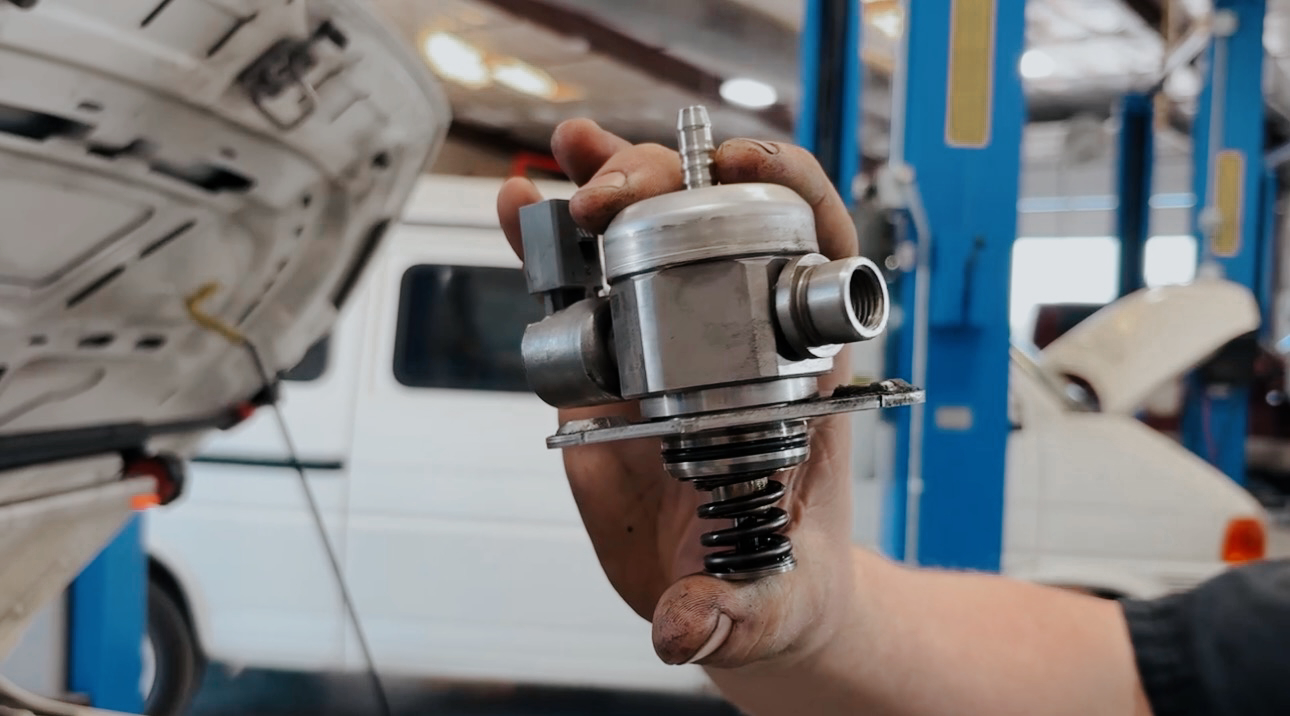
In newer systems, there’s no vacuum line to the regulator at all. Instead, it functions essentially as a check valve — if fuel pressure gets too high, it dumps fuel back into the tank. The real work is done by a high-pressure fuel pump driven off the camshaft, and a quantity control valve that communicates with the fuel pressure sensor to tell the pump whether to build more pressure or hold steady.
— Nick Gerelman, Volkswagen Technician, Fifth Gear Automotive Repair — Aubrey–Crossroads
Quick Reference: Old vs. New VW Fuel Systems
✓ Older VW models: Vacuum-controlled fuel pressure regulator with return line to tank
✓ Newer VW models (e.g., 2020 Passat): Check valve regulator + high-pressure camshaft-driven pump
✓ Newer systems offer better performance, fuel delivery, and emissions — but require different diagnostics
Common Causes of Volkswagen Fuel Pressure Regulator Failure
Both older and newer Volkswagen fuel systems can develop problems, but the causes — and the warning signs — are different depending on which generation of vehicle you drive.
1. Dirty or Contaminated Fuel
Over time, dirt and deposits can clog the internal passages of the fuel pressure regulator, restricting fuel flow and causing inconsistent pressure. This is more common in older systems and is one of the reasons professional mechanics recommend using quality fuel and maintaining a clean fuel system.
2. Vacuum Line Problems (Older VW Models)
On older Volkswagens, the vacuum-controlled regulator depends entirely on the integrity of the vacuum hose connecting it to the intake manifold. If that hose cracks, disconnects, or deteriorates from engine heat, the regulator can’t function properly.
On older Volkswagens, the most common things we see are loose vacuum hoses, broken hoses, or bad diaphragms within the vacuum-controlled regulator. And if you’ve got a failed regulator, you want to put eyes on the other vacuum-controlled components too — things like the EGR switching valve and the boost pressure switching valve. Take a look at the overall condition of the other vacuum lines while you’re in there.
— Nick Gerelman, Volkswagen Technician, Fifth Gear Automotive Repair — Aubrey–Crossroads
3. Running Your Tank Too Low (Newer VW Models)
This is the most preventable cause of fuel system failure on newer Volkswagens — and one of the most common things our technicians see in the shop.
On newer Volkswagens, the people who continuously run their vehicle low on fuel are typically the ones having fueling issues. These low-pressure pumps are inside the fuel tank — they’re lubricated by the fuel and cooled by the fuel. If you’re constantly running on low fuel, you’re aerating the fuel mixture going into that pump. The air causes a lack of lubrication, and not having fuel surrounding the pump means it can’t shed heat properly. You end up burning up the low-pressure pump, and that air can make its way up to the high-pressure pump and damage that too.
— Nick Gerelman, Volkswagen Technician, Fifth Gear Automotive Repair — Aubrey–Crossroads
The Most Important Maintenance Tip for VW Owners
✓ Keep at least a quarter tank of fuel in your vehicle at all times
✓ The fuel pump lives inside the tank — it uses fuel for both lubrication and cooling
✓ Running consistently low accelerates wear on both the low-pressure and high-pressure fuel pumps
✓ Check your door jamb or gas cap for the minimum octane rating your VW requires
4. Failing Fuel Pump
Sometimes the problem isn’t the regulator itself, it’s the pump feeding it. When the fuel pump begins to wear out, it can’t deliver consistent pressure, which can create a lean condition in the engine. Left unaddressed, this can lead to serious internal engine damage.
5. Electrical Faults (Newer VW Models)
Newer Volkswagen fuel systems rely heavily on sensors, wiring, and electronic control modules. A faulty fuel pressure sensor, damaged wiring harness, or failing quantity control valve can disrupt the entire system, leading to stalling, misfires, or a no-start condition.
Warning Signs Your Volkswagen Has a Fuel System Problem
Fuel pressure regulator issues don’t always announce themselves dramatically. Here are the symptoms to watch for:
⚠ Check engine light illuminated
⚠ Engine misfires or rough idle
⚠ Hard starting or extended crank time
⚠ Vehicle stalls while driving
⚠ Reduced fuel economy
⚠ Crank-no-start condition (engine turns over but won’t fire)
When a customer comes in with a fueling issue, it could be something as simple as a misfire, or as serious as a crank-no-start or the car shutting off while driving. That little check engine light on the dash is the first sign. Bring it in, let us scan the code, and let’s see what we’ve got. If you let this go unaddressed for too long, you could be damaging the low-pressure pump, causing damage to the high-pressure pump, burning valves, damaging cylinder walls — or even causing the catalytic converter to fail prematurely.
— Nick Gerelman, Volkswagen Technician, Fifth Gear Automotive Repair — Aubrey–Crossroads
How Our Technicians Diagnose VW Fuel System Issues
Fifth Gear Automotive uses a methodical, tool-driven diagnostic process — not guesswork. Nick walks through what that looks like for a newer Volkswagen:
Diagnostics starts with a full code scan. Most of the time we see low pressure on the high-pressure system. From there, we use a fuel pressure gauge to check the actual low-pressure system and see what readings we have. If everything looks good there, we move to the high-pressure side and verify that the quantity control valve is opening correctly. If it is, we check the injectors to see if something’s stuck open or not opening at all. In more extreme cases, we’ll use an oscilloscope to look at the waveforms and confirm the engine control module is actually sending signals to the injectors.
— Nick Gerelman, Volkswagen Technician, Fifth Gear Automotive Repair — Aubrey–Crossroads
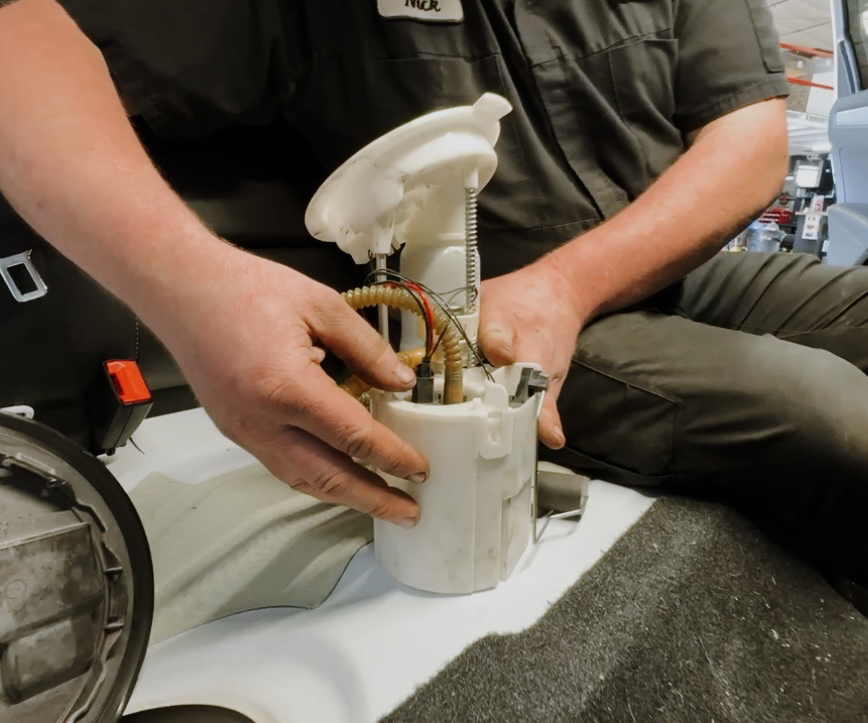
This step-by-step approach means we identify the actual cause — not just replace parts until the problem goes away. That’s dealer-quality diagnostics at independent prices.
How to Protect Your Volkswagen’s Fuel System
The good news: most fuel system problems in newer Volkswagens are preventable. Our technicians recommend the following:
- Keep your fuel level above a quarter tank at all times — this is the single most impactful thing you can do
- Use the correct octane fuel — check the fuel door or owner’s manual for the minimum rating required
- Don’t ignore the check engine light — early diagnosis prevents much more expensive repairs down the road
- Schedule regular inspections, especially if your VW is older and uses vacuum-controlled systems
- Have vacuum lines inspected periodically on older models — heat exposure causes them to crack and fail over time
Why North Texas VW Owners Trust Fifth Gear Automotive Repair
At Fifth Gear Automotive Repair, we’ve been serving North Texas drivers since 2004. We’re a family-owned shop with dealer-level diagnostic equipment and technicians who invest in ongoing training — because vehicles like Volkswagen are constantly evolving.

At Fifth Gear, we truly believe that training is vital. We’re regularly taking new courses on what’s coming out, what we’ve got going on in the shop — and sometimes just taking refresher courses to make sure we’re staying sharp. These fuel systems are constantly changing, and you have to keep up.
— Nick Gerelman, Volkswagen Technician, Fifth Gear Automotive Repair — Aubrey–Crossroads
We service Volkswagen vehicles across the DFW area, with convenient locations throughout North Texas:
Whether you’re dealing with a check engine light, a rough idle, or you haven’t had your VW’s fuel system looked at in a while, our team is ready to help.

Schedule Your Volkswagen Inspection Today
Dealer Quality Service at Independent Prices — Across North Texas
Visit or call your nearest Fifth Gear Automotive Repair location
About the Expert: Nick Gerelman
Nick Gerelman is a Volkswagen technician at Fifth Gear Automotive Repair’s Aubrey–Crossroads location. He specializes in VW fuel systems and regularly participates in advanced technical training to stay current with evolving vehicle technologies.
Frequently Asked Questions
What are the symptoms of a bad fuel pressure regulator in a Volkswagen?
Common symptoms include a check engine light, rough idle, engine misfires, hard starting, stalling while driving, and reduced fuel economy. In severe cases, the engine may not start at all.
How do I know if my VW fuel pump is damaged from running on low fuel?
Signs include low fuel pressure codes, poor acceleration, engine stumbling under load, and difficulty starting. A proper diagnosis with a fuel pressure gauge is the most reliable way to confirm pump health.
Does Fifth Gear Automotive service all Volkswagen models?
Yes. We service all VW models — both older vacuum-controlled fuel system vehicles and newer high-pressure direct injection systems like those found in the 2020 Passat and other modern VWs.
Where can I get my Volkswagen inspected in the Lewisville or Frisco area?
Fifth Gear Automotive Repair has multiple locations across North Texas, including Lewisville, Frisco, McKinney, Argyle, Allen, Aubrey–Crossroads, and Castle Hills. Visit fifthgear.biz to schedule a service appointment.

Juan is a marketing enthusiast with over three years of experience in automotive marketing and serves as the Marketing Lead at Fifth Gear Automotive Repair. A University of North Texas graduate with a Master’s in Marketing, he works closely with expert technicians to share trusted insights and practical advice, helping drivers better understand and care for their vehicles.