By: John Miller, Director of Business Development • Published: September 17, 2026 • Updated: September 17, 2026 • Read Time: 9 min
TL;DR
Clicking that changes when you steer is usually a worn outer CV joint. It’s loudest on slow, tight turns, the kind you make pulling into a parking space. A hum or growl that rises with your speed instead is usually a wheel bearing. That one distinction tells you which repair conversation you’re about to have.
A technician separates the two by what the noise responds to. Several other components produce a similar click, and a few of them cost far less to fix.
What clicking in a turn usually means
A rhythmic click or pop that shows up when you turn the wheel, and gets louder the tighter and slower the turn, is the classic signature of a worn outer CV joint.
The outer CV joint sits at the wheel hub, at the end of the drive axle. Its job is to keep sending power to the wheel at a constant speed while that wheel is also steering and moving up and down over bumps. It does that through a set of hardened steel balls riding in machined grooves, packed in grease and sealed inside a rubber boot.
When the joint wears, those balls and grooves go loose: they start moving against each other where they should fit tight. Turning the wheel loads the joint at an angle, the worn surfaces skip instead of rolling smoothly, and you hear it as a click. Which is why the noise appears when you turn and disappears when you straighten out. You’re only loading the joint hard enough to hear it at steering angle.
Clicking also tells you the problem has been running for a while. A CV joint doesn’t wear out from mileage alone. It wears out because its boot tore at some point and the grease got contaminated with road grit, and that process is silent until the joint has gone loose enough to hear. We photographed what it does inside the joint in Torn CV Boot: Can You Keep Driving, and What Happens If You Don’t Fix It?, using an ’87 Porsche 944 that nobody caught in time.
How to tell a CV joint from a wheel bearing
Both fail at the same wheel and both get described as “a noise when I drive,” so they get confused constantly. The separation comes down to what the noise responds to.
A wheel bearing responds to your speed. A CV joint responds to your steering.
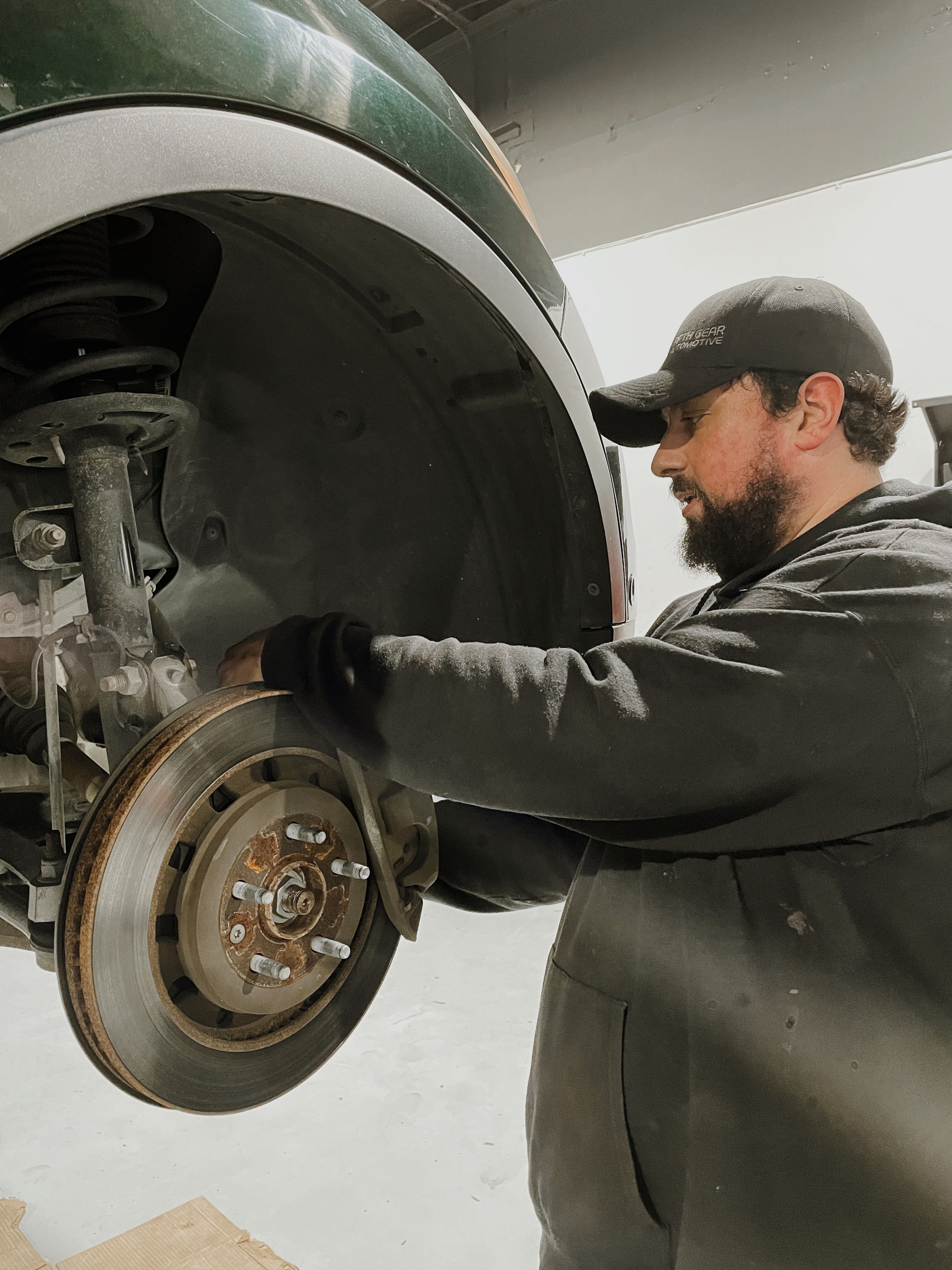
“With the vehicle on the lift, we check the wheel bearing for play or roughness and inspect the CV axles and boot at the same time. A CV joint usually clicks more when you’re turning, while a wheel bearing is more or a humming or grinding that changes with speed, and if it’s still not obvious, we’ll put a stethoscope on it to pinpoint exactly where the noise is coming from.” – Chris Gustafson, Production Lead, Fifth Gear Automotive Repair.
A failing wheel bearing hums, drones or growls, and that noise rises and falls with your road speed. It’s there when you’re driving straight. It often changes character when the car leans onto or off that wheel, so it may get louder in a long sweeping curve, but it won’t produce a distinct rhythmic click in a tight parking-lot turn.
A failing CV joint clicks, and the click follows the steering wheel. It’s most obvious at low speed and full lock. And a bad CV joint generally does not vibrate when you’re driving straight down the road.
| What you notice | Most likely culprit |
|---|---|
| Rhythmic clicking or popping, worst on slow tight turns | Outer CV joint |
| Humming or growling that rises with road speed | Wheel bearing |
| Clunk when you accelerate, and again when you let off/td> | Inner CV joint |
| Shudder under hard acceleration at highway speed, gone when coasting | Inner CV joint |
| Grease splattered on the inside of the wheel, no noise yet | Torn CV boot, joint may still be fine |
| Single clunk or creak over bumps, unrelated to turning | Suspension: sway bar, end link, strut mount |
Neither one is a wait-and-see item, but they fail differently. A wheel bearing left long enough can seize. A CV joint left long enough can lose drive to that wheel and take your steering feel with it.
Inner joint or outer joint? What the noise narrows down
Every drive axle has two CV joints, and they tell on themselves differently.
The outer joint is at the wheel end. It handles steering angle. When it wears, you get clicking and popping in turns, the symptom most people arrive with.
The inner joint is at the transmission or differential end. It handles the in-and-out plunge as the suspension travels. When it wears you usually get no turning click at all. You get a clunk on acceleration and again on deceleration, or a shudder and shake under hard acceleration at highway speed that smooths out the moment you stop accelerating and coast.
Whether the vibration disappears when you coast is diagnostically useful. A vibration that’s present at a given speed regardless of throttle is usually a tire, a wheel balance or a driveshaft issue. A vibration that only shows up under load points at the drivetrain, and an inner CV joint is high on that list. Telling us which one you have shortens the diagnosis.
On a front-wheel drive car, both joints are up front. On rear-wheel and all-wheel drive vehicles, including a lot of the European cars we work on, there are CV axles at the back too, and sometimes at both ends. A clicking noise from the rear of an AWD car surprises people who’ve only read front-wheel-drive advice online.
What else makes a car click or pop in a turn
Clicking in a turn is not proof of a CV joint. Several other components produce a similar noise, and a few of them are much cheaper to fix.
- Sway bar bushings and end links. Worn links clunk or pop as the bar loads up in a turn, on the same timing as a CV joint.
- Strut mounts and bearing plates. A failing upper strut mount can pop, creak or bind as the strut rotates with the steering. Distinctive tell: you may hear it turning the wheel while parked.
- Wheel bearings. A badly worn bearing can add a clicking or grinding component on top of its usual hum.
- Brake hardware. A loose caliper, worn pads or a shifted shim can click as the wheel rotates. Usually speed-related rather than steering-related, but not always.
- Low or aerated power steering fluid on hydraulic systems: a groan or whine at full lock rather than a click, though people often describe it as a noise when turning.
- Something in the wheel. A stone lodged in a wheel cover or between the rotor and a shield clicks convincingly and costs nothing to fix. We have found more than one.
These overlap enough that a phone call can’t separate them. The answer comes from getting the car in the air, grabbing the axle to feel for looseness, spinning the hub and looking at the boot. Ten minutes on a lift beats any amount of guessing.
What does help when you call is describing what the car is doing. Does it click when you turn, or when you accelerate? Only at low speed, or on the highway too? Does it change when you brake? Is there anything on the inside of the wheel? Those answers tell us where to start, and “my car does this specific thing” is exactly the call we want.
“A customer brought a Toyota RAV 4 into our McKinney shop describing a clicking noise when turning, the classic symptom that points most people straight to a CV axle. The noise matched closely enough that a CV joint was the first suspect. On the lift, though, the axles and boots checked out, and the real cause turned out to be a worn sway bar link that was shifting and popping as the suspension loaded up in a turn. The fix was a fraction of the cost of an axle replacement, and it’s a good example of why we confirm the source of a noise before replacing parts.” – Chris Gustafson, Production Lead, Fifth Gear Automotive Repair.
How long can you keep driving on a clicking CV joint?
Get it inspected soon, and don’t plan a road trip on it. No honest mileage figure exists for this, and any number you’re given is a guess.
Clicking tells you the joint has gone loose, but not how far. A joint at the start of that curve may run for a while. A joint that’s been grinding grit for two years may be close to done. Nobody can tell which from the driver’s seat.
The failure mode is clearer. When a CV joint fails completely, that wheel stops receiving power. Steering can go vague or erratic. You’ll usually get heavy vibration and loud clunking or grinding first. At highway speed or mid-turn, that becomes a question of controlling the car rather than repairing it.
So the escalation is simple. Clicking only, car otherwise normal: book an inspection. Clicking that’s become a clunk, or clicking plus new vibration: stop driving it and call for a tow. Trading a tow bill for the alternative is an easy trade.
What to expect when you bring it in
We won’t quote you a CV axle over the phone.
“CV axle” describes several different jobs. Whether you need a boot or a complete axle depends on whether the joint is already damaged, and that’s a visual determination. Whether it’s one wheel or two, front or rear, front-wheel drive or all-wheel drive, changes the labor. Whether an OE or a quality aftermarket part is the right call depends on the application. And on a fair number of cars the click turns out to be something else entirely, which is the best possible outcome for you and impossible to predict sight-unseen.
So the inspection comes first. We put the car on a lift, check each axle for looseness, inspect the boots for tearing and grease loss, spin the hubs to isolate bearing noise and check the suspension components that mimic CV symptoms. Then you get one number for the actual repair instead of a range wide enough to be useless.
Fifth Gear Automotive Repair has ten locations across DFW (Allen, Argyle, Aubrey-Cross Roads, Autosports, Castle Hills, Frisco, Lewisville, McKinney, North Fort Worth and Southlake) and you can schedule a CV axle inspection at any of them.
Frequently Asked Questions
Is clicking when turning always a CV joint?
No. Worn sway bar bushings or end links, failing upper strut mounts, wheel bearings, loose brake hardware and even a stone lodged in a wheel cover can all produce a click that appears in turns. Isolating the cause requires putting the vehicle on a lift and checking each component for looseness, which a phone diagnosis cannot do.
What's the difference between CV joint noise and wheel bearing noise?
A CV joint clicks in response to steering input, and is loudest during slow, tight turns. A wheel bearing hums or growls in response to road speed, and is audible while driving straight. A bad CV joint generally does not cause vibration when the vehicle is travelling in a straight line, which is often the clearest way to separate the two.
How long can I drive with a clicking CV joint?
No mileage figure holds up here, because clicking tells you the joint has gone loose but not how far. Have it inspected promptly. If the clicking progresses to clunking or is joined by vibration, the vehicle should be towed rather than driven, because complete joint failure causes loss of drive to that wheel and can affect steering.
Does clicking when turning mean I need a new axle, or just a boot?
If the joint is audibly clicking, there is already wear inside it, and a boot replacement alone will not resolve the noise. Boot-only repair is the option while the boot is torn but the joint is still quiet and undamaged. An inspection determines which stage the axle is at.
Can I drive it to the shop, or should I have it towed?
If the only symptom is clicking in turns and the vehicle otherwise drives normally, a short trip to the shop is generally reasonable. If the noise has become a clunk, or there is new vibration, or the steering feels different, have the vehicle towed. Complete CV joint failure at speed is a handling problem, not just a repair.
Methodology
The diagnostic sequence in this post is the one our technicians run on the lift: check each axle for looseness, inspect the boots for tearing and grease loss, spin the hubs to isolate bearing noise, then check the suspension parts that mimic CV symptoms. Fifth Gear Automotive Repair services all makes and models, domestic and import, across ten Dallas-Fort Worth locations: Allen, Argyle, Aubrey-Cross Roads, Autosports, Castle Hills, Frisco, Lewisville, McKinney, North Fort Worth and Southlake. We specialize in European auto repair for BMW, VW, Mercedes, Porsche, Audi, Volvo, Jaguar, Land Rover and most other popular European marques, and most of the vehicles we service are not European.
Sources & Further Reading
- Inner vs. Outer CV Joint Failure, GSP North America: which joint produces which noise
- CV Joint Noise and Other Related Symptoms, CarParts.com: inner-joint clunk on acceleration and deceleration
- What Is a CV Joint? Carfax: CV joint function and construction
- Torn CV Boot: Can You Keep Driving, and What Happens If You Don’t Fix It?
- Don’t Ignore These Car Noises
- CV Axle Service & Repair
- Drive Train Service | Auto Repair in Lewisville, TX
Last updated: September 17, 2026

John Miller is the Director of Business Development at Fifth Gear Automotive.
Fifth Gear Automotive Repair provides automotive service and repair. We service all makes and models – both domestic and import. We specialize in European auto repair for BMW, VW, Mercedes, Porsche, Audi, Volvo, Jaguar, Land Rover and most other popular European marques.
Fifth Gear Automotive has 10 locations – Allen, Argyle, Aubrey-Crossroads, Castle Hills, Frisco, Lewisville, McKinney, North Fort Worth, and Southlake, Texas.